
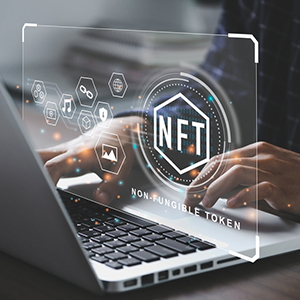
There has been a surge in the popularity and value of non-fungible tokens (NFTs) since they were first envisioned, and despite the ups and downs of the crypto marketplace, they remain a popular option for many exploring this exciting digital space.
First off, what is an NFT?
An NFT, or a non-fungible token, is a special type of token that cannot be substituted. Each NFT is unique and is owned by a single entity – similar to how you would own a car or house.
Other things, such as cryptocurrency and cash money, are fungible, which means you can exchange them for one another. Meanwhile, an NFT is non-fungible, meaning you cannot trade or exchange it for an equivalent unit.
Every NFT is a unique item and has multiple features that distinguish it from digital currencies:
- Indivisibility: You cannot divide NFTs into smaller denominations as you can with cryptocurrencies.
- Non-Interoperability: This means that NFTs are not equal to one another because they can neither be traded nor exchanged.
- Authenticity: Every NFT has an owner. Smart contracts govern all NFTs, and the authenticity of every token can be verified through blockchain ledgers.
- Tradability: NFTs can be traded and resold to generate handsome profits.
Considering these properties of NFTs, it’s understandable why many people are interested in these tokens. However, you need to know which blockchains are the best for NFT development.
Top 3 blockchains used by NFT developers and the skills needed to create content
A blockchain is a distributed ledger that stores records of digital transactions. These decentralised ledgers provide a transparent and secure ecosystem for running smart contracts on a decentralised system.
Blockchain development is a hot skill in the market, but not all blockchains are designed to manage NFT transactions. Some blockchains lack the features needed to build NFTs.
Here are the top three blockchains for NFT development and the skills NFT developers must have to use these platforms.
- Ethereum (ETH)
Ethereum is undeniably the most commonly used blockchain to develop NFTs. It has a massive community of developers, which puts the blockchain at an advantage since bugs can be fixed and new features can be added regularly.
Ethereum also has many technical documents that developers can use to build smart contracts or decentralised apps. The popular token standard on Ethereum used to build NFTs is ERC-721.
Meanwhile, the ERC-1155 token standard is widely used to create semi-fungible tokens.
Recently, Ethereum also proposed another standard, EIP-2309. It is expected to facilitate NFT minting, allowing developers to mint an unlimited number of tokens per transaction.
The following reasons make Ethereum a useful platform for NFT development:
- Ethereum allows users to verify token metadata and transaction history publicly: This makes it easy to prove the ownership history of the NFT. After confirming a transaction, it’s almost impossible for that data to be manipulated. Therefore, it’s not possible to steal the NFT ownership.
- Ethereum allows peer-to-peer NFT trading: This cuts the need for platforms that take a massive share of the transaction as compensation.
- The tokens are always available for sale: since Ethereum doesn’t ever go down.
Required Tech Skills
When you hire NFT engineers to develop NFTs on Ethereum, make sure they have the following skills:
- Understanding of Cryptography: The developer should have a solid understanding of cryptography for creating and verifying digital signatures. Understanding the basics of cryptography will ensure the security of NFT transactions. They should know about ring signatures, encrypted storage, hash functions, zero-knowledge proofs, and private key encryption.
- Web Development: Since a large part of Ethereum’s decentralised app (App) web traffic is via browsers, the ideal candidate must have strong knowledge of HTML, JavaScript, and CSS to implement necessary features into an NFT.
- ERC-721 Token Familiarity: The NFT developer should understand the ERC-721 standard and the various use cases of the token. Since most NFTs on Ethereum are built based on this standard, they must know how to create and implement ERC-721 in their project.
- Solidity: The blockchain and cryptocurrency expert should be familiar with Solidity development and its tools like Truffle for developer workflow.
- Flow (FLOW)
Flow is a PoS-based blockchain made specifically to mint NFTs and create crypto apps or games. Since its launch in 2020, it has become an alternative to Ethereum for NFT development.
Smart contracts on Flow are powered by Cadence, which is a proprietary programming language the blockchain’s developers have made.
The platform has multi-role and multi-node architecture that is instrumental in transaction processes, such as verifying NFTs.
One of the noteworthy features of Flow that make it suitable for NFT development is its superior performance. More than 10,000 transactions can be executed on the platform every second.
The features of Flow that make it suitable for building NFTs include:
- Cadence: The easy-to-learn programming language has been made specifically for the platform to develop digital assets and apps.
- Flow Client Library: The Flow Client Library is a browser-based collection of functions and features that can be used to build NFT projects on the platform.
- Upgradeable Smart Contracts: NFT developers can patch bugs and upgrade some parts of smart contracts securely on the blockchain.
- User-Ready Experience: The blockchain supports ecosystem optimisation and has multiple payment onramps that make it ready for consumer applications.
- Required Tech Skills
NFT developers that use Flow must be familiar with Cadence, the programming language used by Flow to code transactions, scripts, and smart contracts.
The design of Cadence is inspired by the languages Move and Rust. Developers should know how to write the following three Cadence programs:
- Contracts: A contract is a program deployed to Flow, starting your NFT’s logic. It allows access to all the capabilities and resources your token has. The common constructs of a contract are interfaces and resources. A resource is an item that is stored in the user’s account. Resources are accessible based on the access control measures defined by the smart contract. The interface defines the capabilities or behaviours of the resources.
- Transactions: The transaction indicates to the on-chain contract that the state of the chain should be changed. In this regard, Flow is similar to Ethereum since the change is irreversible.
- Scripts: On Cadence, scripts are programs that read the blockchain’s state. Developers do not require an account to sign up for scripts, nor do they have to pay gas fees.
- Solana (SOL)
Solana has quickly become a competitor for Cardano and Ethereum since it is a comparatively faster programmable blockchain. The blockchain has hundreds of projects, including Web3, DeFi, and NFTs.
The platform can execute 65,000 transactions every second, which makes it a highly attractive blockchain due to fast order execution.
Solana’s minting program — Candy Machine — allows NFT developers to focus on their artwork rather than writing new smart contracts. The program provides support across the ecosystem and lets developers customise the program accordingly.
The Solana ecosystem gives developers access to DAOs, artist collectives, marketplaces, and rationalisation tools.
Launchpad on Solana is a product from Magic Eden that lets creators mint collections even with little technical knowledge.
Solsea, the NFT marketplace on Solana, is so popular that Coachella 7Music Festival struck a deal with FTX to launch Solana NFTs.
Required Tech Skills
Here are the tech skills NFT developers need to use Solana for minting:
- C, C++: Expertise in C and C++ is a prerequisite for the Solana platform since writing on-chain programs is done using C and C++.
- Rust: Rust is an intermediate programming language that enables developers to develop applications and libraries on top of it. The developer must be familiar with data structures, object-oriented programming, and other common constructs of a typical general-purpose language such as package manager, build systems, testing frameworks, etc.
This article is part of a series of articles we hope to deliver in the coming months to give you an idea of the opportunities available within the NFT market and how we can assist you with the launch of your next NFT project.
Want to learn more about our services for cryptoassets? Speak to Raz Miah today!
*Disclaimer: The article should not be taken as and is not intended to provide any investment advice. Claims made in this article do not constitute investment advice and should not be taken as such. Grunberg & Co Ltd shall not be responsible for any loss sustained by any person who relies on this article. Do your own research!