
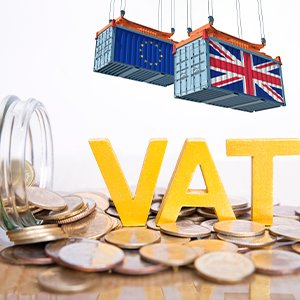
A new set of European Union cross-border VAT rules are set to come into force on 1 July 2021.
Whilst everyone is talking about the changes for B2C (business to consumer) sales of goods, there are also some changes to the B2C supply of services.
How is VAT changing for the supply of services to EU consumers?
The new rules do not change the place of supply of those services but only offer a simplified procedure to declare the VAT due in the EU Member States where the supply takes place.
The new rules extend the scope of the non-Union scheme to all services supplied to non-taxable persons, which take place in a Member State in accordance with the place of supply rules.
This means that from 1 July 2021, businesses not established in the EU supplying services to non-taxable persons (consumers) in the EU, do not need to register for VAT in each Member State in which their supplies of services take place.
Instead, the VAT due on these supplies can be declared and paid in one single Member State (the so-called Member State of identification) via the One Stop Shop (OSS, non-Union scheme).
Examples of B2C supplies of services (a non-exhaustive list) that could be reported under the non-Union scheme are:
- Accommodation services carried out by non-established taxable persons,
- Admission to cultural, artistic, sporting, scientific, educational, entertainment or similar events, such as fairs and exhibitions,
- Transport services,
- Services of valuation and work on movable tangible property,
- Ancillary transport activities such as loading, unloading, handling or similar activities,
- Services connected to immovable property,
- Hiring of means of transport,
- Supply of restaurant and catering services for consumption on board ships, aircraft or trains etc.
What else is changing?
The upcoming changes to VAT also affect the supply of goods to and from the EU. The main changes, from 1 July, are as follows:
- Online sellers, including online marketplaces and platforms, will need to register in one EU Member State and this will be valid for the declaration and payment of VAT on all distance sales of goods and cross-border supplies of services to customers within the EU.
- The existing thresholds for distance sales of goods within the EU will be abolished and replaced by a new EU-wide threshold of €10,000.
- Below this €10,000 threshold, the supplies of telecommunications, broadcasting and electronic (TBE) services and distance sales of goods within the EU may remain subject to VAT in the Member State where the taxable person is established.
- Special provisions will be introduced whereby online marketplaces and platforms facilitating supplies of goods are deemed for VAT purposes to have received and supplied the goods themselves – known as the “deemed supplier”.
- New record-keeping requirements will be introduced for online marketplaces and platforms facilitating supplies of goods and services, including where such online marketplaces or platforms are not a deemed supplier.
- A new special scheme for distance sales of low-value goods imported from third territories or third countries will be created – known as the Import One Stop Shop (IOSS).
- The VAT exemption at the importation of small consignments of a value up to €22 will be removed. This means all goods imported in the EU will now be subject to VAT, but simplification measures for distance sales of imported goods in consignments not exceeding €150 will be introduced, in cases where the IOSS is not used for imports.
Everyone in the supply chain will be affected by these new rules, including businesses and e-commerce marketplaces both inside and outside the EU, as well as postal operators, couriers, customs and tax authorities, and even some consumers.
The official EU guidance for these rules can be found here, while HM Revenue & Customs (HMRC) has also published guidance on the new rules here.